
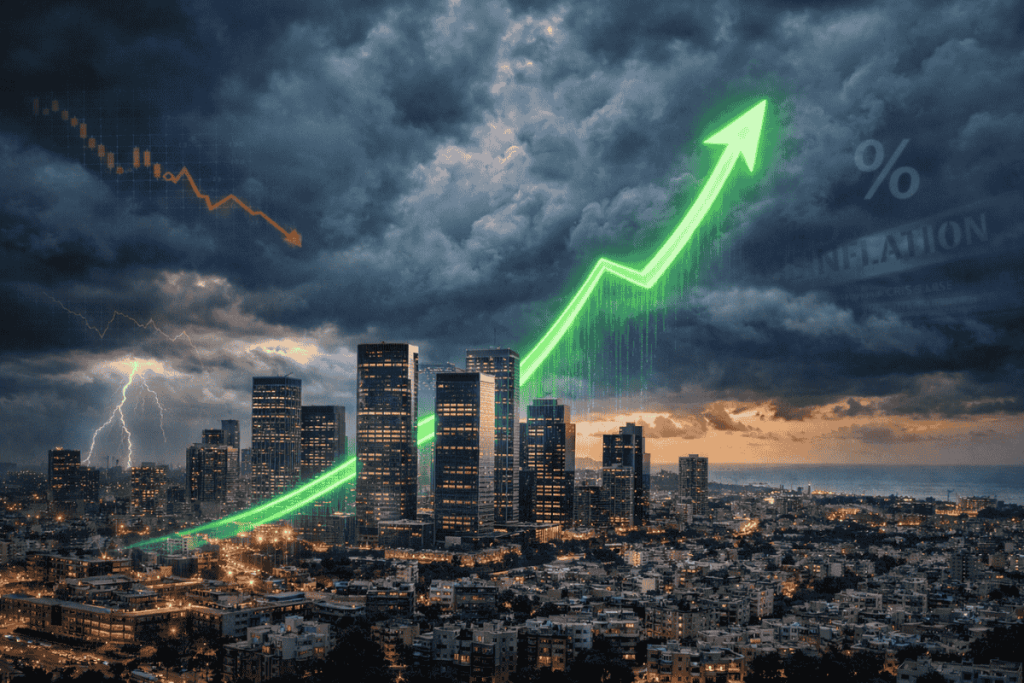
There are moments when a quick glance at the headlines is enough to make it seem as if a country’s economy should be on the verge of collapse. In Israel, those moments arrive quite frequently. In just the past six years we have experienced a global pandemic, worldwide inflation, rising interest rates, political turbulence, and a prolonged war that began after the events of October 7 and left a deep mark on all of us.
On the surface, it seems any one of these events could have pushed an economy into serious financial turmoil. And yet something unusual has happened. Despite this sequence of shocks, Israel’s economy continues to function and, in many cases, even grow.
So what exactly keeps this economy stable? To understand that, we need to look at several unique characteristics of the Israeli economy that help it remain resilient even during periods of significant disruption.
A Small Economy With Global Reach
Israel in the 1980s was a relatively small and fairly closed economy with a heavy dependence on the domestic market. Israel in the 21st century is something very different.
A large portion of Israel’s growth engines are no longer tied to the local market at all. Industries such as software, cybersecurity, biotechnology, and information technology sell most of their services to companies and governments outside Israel. According to the Israel Innovation Authority, the high tech sector alone accounts for roughly 15 percent of Israel’s GDP and close to half of the country’s exports of goods and services.
When a significant portion of economic activity is directed outward, the local economy becomes less dependent on what happens within its own borders. Even during periods of internal tension or security events, companies that sell to the American, European, or Asian markets continue operating within a much broader global economic system.
Crisis? We Are Used to It
But the structure of the economy is only part of the story. Israeli business culture is different in several important ways from that of many other countries. Companies in Israel have operated for decades in an environment where certainty is not the norm.
Decisions tend to be made quickly. Business models change rapidly. Companies often choose to adapt to reality rather than fight it. It does not always look especially orderly, but this flexibility often creates resilience. That resilience is particularly visible in the high tech and startup sectors.
Boring Regulation Is Strong Regulation
Israel’s regulatory framework also plays an important role. Banks, insurance companies, and fintech firms operate under relatively conservative oversight, and banking supervision in Israel is considered among the strictest in the developed world.
This conservatism can sometimes feel restrictive during periods of growth. But in times of crisis it often proves to be a protective layer.
A clear example is the global financial crisis of 2008. One of the major triggers of that crisis was the collapse of the American mortgage market, where millions of borrowers were allowed to take mortgages with almost no equity and little ability to repay them. The result was massive deficits, millions of foreclosures, widespread unemployment, and the collapse of countless companies and households.
While the crisis became a traumatic national event in the United States and spread across Europe, its effects in Israel were far more limited. Israel’s more conservative financial regulation helped shield its financial system from the worst of the shock.
The Return of the Jewish Mother
Beyond these structural elements there is another factor in Israel’s economy that is harder to measure: human capital.
For many years Jewish mothers famously hoped their children would become doctors or lawyers. In recent decades the aspiration for excellence has remained, but the preferred professions have shifted toward engineering, software development, entrepreneurship, and other fields that are in high demand within technology companies.
As a result, Israel has developed one of the highest concentrations of workers in science and technology fields relative to its population. According to OECD data, Israel has one of the highest shares of employees working in research and development in the world.
This has created an environment in which a relatively large share of ideas turn into products, and products turn into companies that sell to global markets.
————
Together, these forces create a phenomenon that can sometimes confuse outside observers. On the one hand, the local reality can appear extremely volatile. On the other hand, the economy itself is built on mechanisms that allow it to continue operating even when the surrounding environment shifts dramatically.
Does that mean the Israeli economy is immune to crises? Of course not. In fact, some of its strengths can also be vulnerabilities. Israel’s heavy dependence on the technology sector, for example, makes the economy sensitive to changes in global technology markets.
It is even possible that the AI revolution and its impact on the SaaS industry could create a larger disruption than many of the wars or pandemics of recent years.
But from a broader perspective, the past few years present an interesting picture. An economy operating in a highly complex environment, yet still managing to maintain relative stability.
And perhaps that is the most fascinating characteristic of the Israeli economy. Its stability does not come from calm conditions, as is sometimes the case in parts of Europe. Instead, it comes from resilience that is built inside a constantly changing reality.